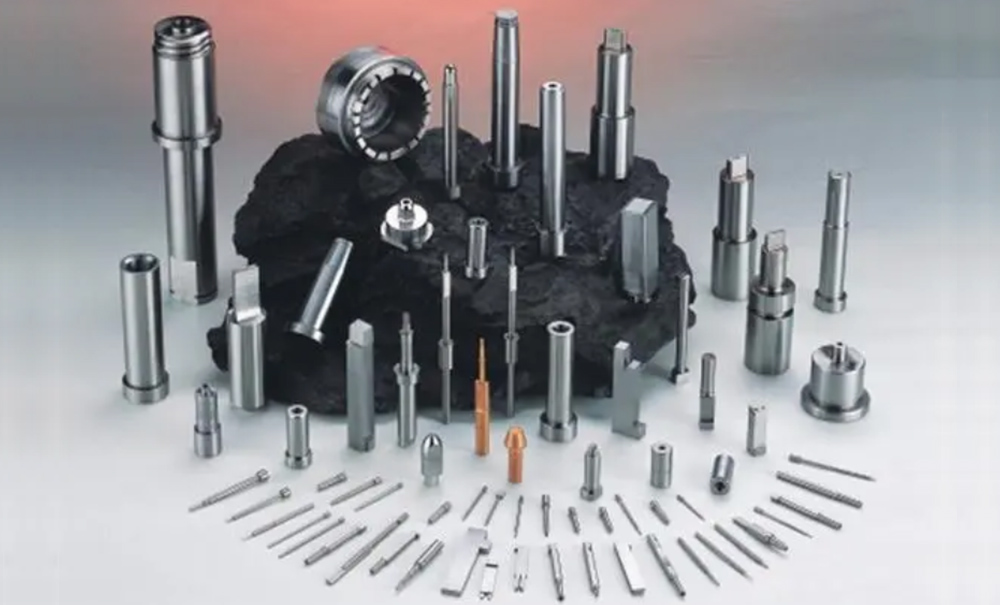
Talking about precision parts, there are various kinds of them, there are various kinds precision components, milled and turned precision parts, grinding and EMD precision parts, etc. Most of them are machined by CNC machining process. Precision parts manufacturers professionally manufacture these kinds of parts that are used for various kinds of molds, dies, tools, or automation.
According to the materials classifications, there are stainless steel precision parts, aluminum alloy precision parts, brass precision parts, plastic precision parts, and also hard metal (carbide) precision parts, etc.
Precision parts also can be called precision components. A precision component manufacturer should have precision machining equipment, such as CNC milling machines, CNC turning machines, CNC grinding machines, CNC EDM/WEDM machines, etc.
let’s look at various kinds of machined precision parts and their machining methods below.
Precision Parts Classifications by Manufacturing Methods
Milled precision parts
Milled precision parts are the parts made by milling technology. Milling technology can perform cutting, turning, and drilling functions in one machine. There are manual milling machines and CNC milling machines. The CNC milling machines also have the 3-axis and 5-axis categories. Some precision parts suppliers have 5-axis milling machines, and some use 3-axis machines. Usually, a 3-axis CNC milling machine can control the milled parts with a precision of +/-0.05mm; a 5-axis CNC milling machine’s precision can be 0.001mm to 0.1mm. 3-axis CNC mills are not precise enough for high-precision machining compared to grinding or EDM. But 5-axis CNC mills can reach higher precision. CNC milling has the advantage of high-speed machining. The milled precision parts are available in a variety of materials, for example, stainless steel, aluminum, Bakelite, plastic, or wood.
Turned precision parts
Turned precision parts, also called cylindrical parts, are mechanically machined by turning as a manufacturing process. Turning usually use a round rod or square hexagonal bar materials. CNC turning has various kinds of turning machines, for example, CNC Lathes, CNC Jig grinding machines, and some semi-automatic cylindrical turning and grinding machines. Usually, CNC Lathe is a must turning machine for a precision turned parts factory.
Some of the circular punches and dies, ejector pins and sleeves, guide pins, and bushings are all machined by turning technology. CNC turning can get different stages of accuracy by different turning machines and turning technologies. Some can get +/-0.05mm, some can get +/-0.0001mm.
Grinding precision parts
Grinding precision parts, as its meaning, are machined by grinding technology. Compared to milling and turning, grinding can get more precision sizes for the components. No matter by semi-auto surface grinding or by CNC profile grinding, we both can get the +/-0.001mm tolerance. And can get a good mirror surface effect. But grinding technology also needs experienced skills and longer working time. So it cost more than any other kind of machining technology.
EDM precision parts
EMD is the abbreviation of Electrical Discharge Machining. There are two kinds of EMD, wire EMD, and sinker EDM. EDM works by creating an electrical charge that emits sparks, it uses the spark to cut or melt away the metal. There is a precondition that the materials of machining parts should be electrically conductive. The materials can be steel, alloys, titanium, and brass.
Wire EDM is also called wire-cut EDM or wire erosion. It uses ultra-thin copper wire to cut or called melt the parts to the needed shape or get the needed R-angle. There is no actual contact is made between the wire and the machined material. It prevents distorting the path of the wire or damaging the part. Sparks jump the gap and melt away excess metal.
Sinker EDM, also called Die Sinking EDM is used to produce components with high precision through spark erosion. The process requires an insulating fluid, electrodes, and a power supply. The electrodes and workpieces are connected to each other with the help of a power supply unit. An electric spark is generated between the electrode and the workpiece. The spark generates intense heat in the range of 8,000 to 12,000°C, melting any surface it touches. EDM process literally sinks the profile of the electrode onto the work-piece surface and this is why it is also called “Die Sinking”.
Laser precision parts
Laser Processing is one of the precision parts manufacturing methods. It also can produce high-precision parts, but it is not the mechanical way. Laser processing is using a very high-temperature laser beam to cut and process the parts. The high temperature would change some of the characteristics of the processing edge of precision parts. This may affect the precision parts’ physical characteristics. If there are no high requirements for the physical characteristics, laser processing parts would be a good choice.
3D Printing parts
3D printing is a new technology that already exists in the market for years. It also can produce high-precision parts. But the 3D printing parts have a lower hardness and are non-wear resistant. If the precision parts have higher hardness requirements and need good wear-resistant character, 3D printing is not the choice. Professional precision parts machining companies usually don’t need to have one.
But it is very suitable for making the newly developed products’ prototypes of the new designs and drawings. So a tooling mold company may often use a 3D printer to make prototypes.
Precision Parts Classifications by Manufacturing Usage
Precision Parts for Metal Stamping Tools and Dies
These precision parts can be called stamping die components. They are mainly used for metal stamping dies and punching tools. for example, punches and dies, guide pins and bushings, blocks, springs, etc.
Precision Parts for Plastic Injection Molds
These precision parts can be called precision mold parts. They are mainly used for plastic injection molds. for example, cores and cavities, ejector pins and sleeves, guide pins and bushings, etc.
Precision Parts for Automation Machinery Systems
These precision components for automation machinery systems are mainly mechanical components or fixtures used in automation machines.
We can also classify the precision parts by applications and industries. for example, electronics precision parts, semiconductor precision parts, auto precision parts, medical precision parts, aerospace precision parts, etc. CNC machined components manufacturers sometimes don’t directly serve the end customers but through some mold and tooling companies.
What we talked about above are the small batches or one-off individual precision parts’ machining and processing.
There is also some processing for bulk-quality production. They are known as molds, tools, and dies. To produce the plastic precision parts for bulk, we can use plastic injection molds for large quantity production; To produce the metal precision parts for bulk, we can use metal stamping dies and tools or punching press machines for large quantity production. Here we will not discuss more about the bulk precision parts manufacturing.
Precision component manufacture ltd doesn’t need to have all the machining equipment. They can be keen and skilled in one or two main categories, and know how to integrate various machining methods together to get cost-effective and high-precision parts that meet customers’ requirements. Then that’s ok.