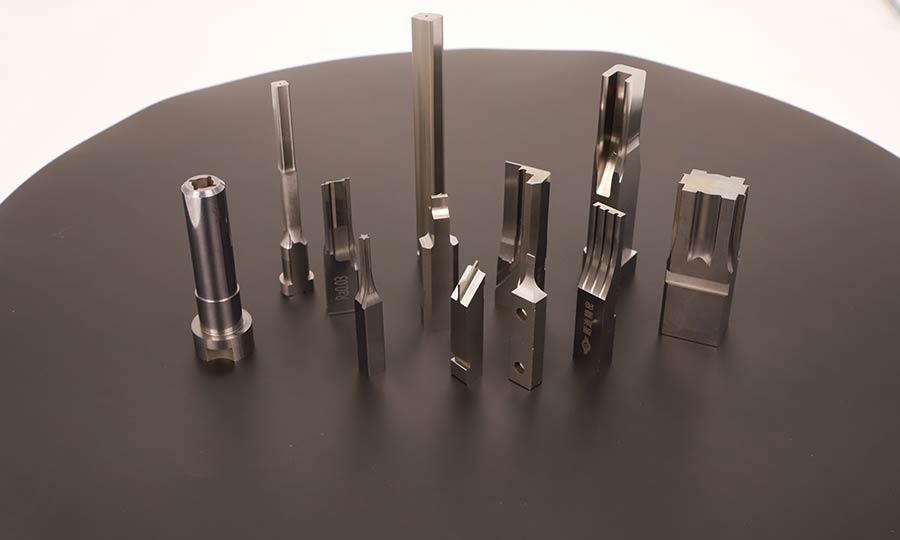
High tolerance machining for stamping die components involves the production of components with extremely tight dimensional and geometric tolerances. This process needs skillful machinists and advanced machining milling turning, grinding machines.
It is critical in industries where even minor deviations can lead to significant performance issues or failures.
Here’s a detailed overview of high tolerance machining for stamping die components:
overview of high tolerance machining for stamping die components
Key Considerations of high tolerance machining
Tolerances:
High tolerance includes two main categories, the Tight Dimensional Tolerances, and Geometric Tolerances.
- Tight Dimensional Tolerances: Typically in the range of ±0.001 mm, or ±0.0001 inches (±0.00254 mm) or even tighter.
- Geometric Tolerances: Includes flatness, roughness, roundness, cylindricity, R-anlge, and positional tolerances. For example, R-angle requirement R0.5; Roughness requirement, Ra0.2.
Machining Processes:
- CNC Milling: For complex 3D shapes and contours.
- CNC Turning: For cylindrical parts.
- Grinding: For achieving very fine surface finishes and tight tolerances.
- EDM (Electrical Discharge Machining): For hard materials and complex geometries.
- Swiss Machining: For small, intricate parts with high precision.
Steps in High Tolerance Machining
There are several steps in the High Tolerance Machining as below:
- Design and Planning: CAD Models, and CAM Programming with specified tolerances.
- Material Selection: Choosing materials based on mechanical properties, thermal stability, and machinability.
- Setup and Calibration: Machine Calibration and Fixture Design are auxiliary for calibrating the dimensions to ensure the tolerance.
- Machining: Usually, there are these 3 steps: Roughing, Semi-Finishing,Finishing.
- Inspection and Quality Control: It includes Dimensional Inspection, Surface Finish Analysis, Statistical Process Control (SPC), etc.
Applications of High Tolerance Machining
It is widely used in the Electronics (Connectors, semi-conductors, housings, heat sinks), Automotive (High-performance engine parts, transmission components), Medical, Aerospace, and Defense industries, etc.
There are also some other factors affect the tolerances, for exmaples:
Materials choosing: there are tool steels, aluminum alloy, bronze alloy, tungsten carbide, or plastic material, PEEK, bakelite, etc.
Equioment: Hig-Speed and High-Tolerance Multi-axis CNC milling machines (3-axis, 4-axis, 5-axis); CNC Turning machines, Optical profile grinding machines, Wire-cut EDM machines, Sinker EDM machines, Plain surface grinding machines, Jig grinding machines for round parts, centerless grinding machines, internal and external cylindrial grinding machines, etc.
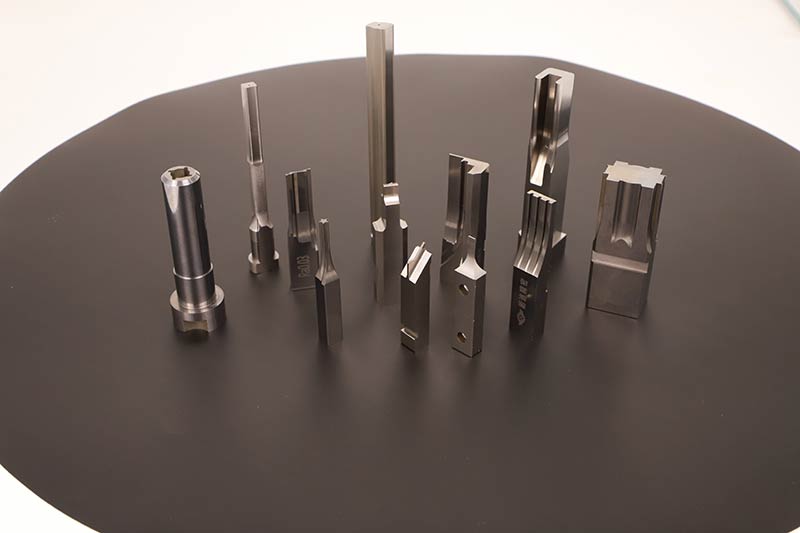
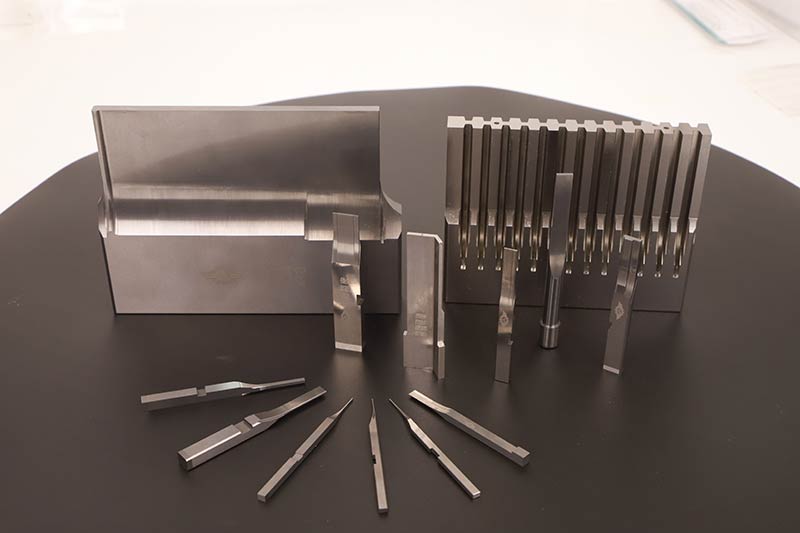
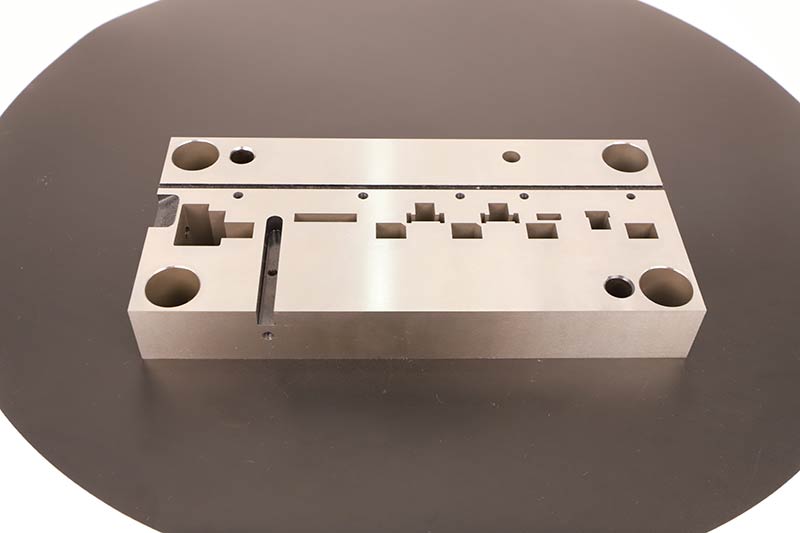
Although High Tolerance Machining for stamping die components has a fixed demand in the market, it also faces some challenges, for example, comparatively higher costs, comparatively longer machining time; High Complexity that less suppliers can make, etc.
But we also make our best pratices, Design for Manufacturability (DFM), Process Optimization, Quality Assurance, Skilled Workforce, and Environmental Control, etc.
By adhering to these principles and practices, high tolerance machining stamping die components manufacturers can achieve the high levels of precision required for demanding applications in various industries.